Thursday, May 28, 2015

Wednesday, May 27, 2015
Westcoast Treetop Walk
Yesterday we decided to check out the Westcoast Treetop Walk and Cafe. The name alone should clue you in to the sort of ad-centric nature of the thing. Here in NZ, where you can pretty much step out the door and count on your jaw to drop, I snarked a little about doing this even as I navigated us there.

Any place in NZ that charges NZ $34/US $25 to walk--I know, I know, we chose to do this--reminds me a lot of the US, where doing anything seems to cost something. Plus, to build this on Department of Conservation land made me wonder who greased whose palm (Chicago life showing there, Pippi?). NZ isn't rife with "tourist attractions." This one was built by an Australian eco-tourism company called Canopy01.
Here's the website for what had the potential to be an overproduced theme park, but turned out to be, well, a new view on the natural world.


Some pretty spectacular views up here, looking down and also to the west. Walking this high does change one's perspective, and we enjoyed it.


Very Swiss Family Robinson in a way, the gently swaying path among the trees.

View from the tower stairs.


Flat whites and carrot cake from the cafe conclude the treetop walk. The Queen of Flat Whites is still snarking a little that she didn't spend 50 bucks riding a horse instead. Now that will shift your perspective...


Any place in NZ that charges NZ $34/US $25 to walk--I know, I know, we chose to do this--reminds me a lot of the US, where doing anything seems to cost something. Plus, to build this on Department of Conservation land made me wonder who greased whose palm (Chicago life showing there, Pippi?). NZ isn't rife with "tourist attractions." This one was built by an Australian eco-tourism company called Canopy01.
Here's the website for what had the potential to be an overproduced theme park, but turned out to be, well, a new view on the natural world.
The walkway is 65 feet up, the tower 150

The walkway leads through the canopy of mature native West Coast forest dominated by rimu at a height of around 20 to 25 metres (66 to 82 ft) above ground. It passes close to the crowns of mature rimu trees and sits well above smaller trees and tree ferns. The loop walk takes in views of the nearby Lake Mahinapua and includes a gently swaying cantilever extending out into the forest canopy. A 47 metres (154 ft)[3] tall steel viewing tower with a spiral staircase offers even more spectacular views over the surrounding forest and northern ranges of the Southern Alps including Toaroha Range, Diedrichs Range and Mt O'Connor, as well as further south in good viewing conditions. The tourist attraction is locally run via a 45-year concession lease[4] from the Department of Conservation NZ.

Some pretty spectacular views up here, looking down and also to the west. Walking this high does change one's perspective, and we enjoyed it.


Very Swiss Family Robinson in a way, the gently swaying path among the trees.

View from the tower stairs.


Flat whites and carrot cake from the cafe conclude the treetop walk. The Queen of Flat Whites is still snarking a little that she didn't spend 50 bucks riding a horse instead. Now that will shift your perspective...

Campsite in Hokitika
Behind the milk factory (wait, did I just write milk factory?).
Sometimes it's fun to park in town, Harold and Maude-esque.

Sometimes it's fun to park in town, Harold and Maude-esque.
Look at that cute little hedge

Hello From Hokitika + A New Frypan
Full sun today, bringing into focus the NZ Alps to the west of Hokitika, where we're spending a few days.

Tomorrow we hope to explore the numerous pounamu workshops here.
For a small town, Hokitika struck it rich in the resources stakes. Before the gold rushes Maori were already heading here in search of another precious stone – pounamu. The Arahura River is the birth place of pounamu, which is also known as greenstone or New Zealand jade.
Today we shopped for groceries, visited the Takenote Hokitika bookshop, and found a cast iron fry pan at a camping store. The bookshop was packed with NZ titles.

I got The Luminaries, winner of the 2013 Man Booker Prize. The book is set in 1866, and the town is featured in its gold rush story. When I paid, the clerk asked me if I wanted the stamp noting the book was purchased in Hokitika. Well of course I do.


Birds of NZ in books
Fewer than 150 of these flightless NZ parrots remain. Here's a website with more (thanks Brookerz).


The long-sought cast iron frypan turned up in a camping store geared to hunters and fishers. Our caravan range is relatively small, and this will do nicely.

So nicely in fact that returning from a big grocery shop we put it to immediate use.

Better than it looks...mine served on a wooden plate found at the hospice shop in Motueka for $1.50. Cheers! (NB: tiny bottle of pinot noir a freebie tied to the neck of Art's Appleton rum, a cross-cultural gift.)

Monday, May 25, 2015
Birds of NZ: Putangitangi, The Paradise Shelduck
I saw this pair Sunday morning at the mouth of the Pororari River adjacent to our campground in Punakaiki. Aren't they stunning? Not certain, but think I've made a correct ID using NZ Birds online...


Putangitangi,
the paradise shelduck, is endemic to New Zealand, that is it is found
nowhere else in the world. It was discovered first by Captain Cook at
Dusky Sound in 1773 during his second voyage. Cook called it the Painted
Duck. They were not a common bird before settlement by Europeans but
are now one of the endemic birds which has prospered with the conversion
of native forest to pasture. They have increased greatly in numbers
through this century and are now only partially protected.
They are a large duck and are always seen in pairs except during the moulting season. The drake has a black head with a greenish gloss, the body being dark grey barred with black. The undertail and tertials are orange chestnut. The duck has a white head and the body is a bright orange chestnut.
- See more at: http://www.nzbirds.com/birds/putangi.html#sthash.1WxXismE.dpuf
They are a large duck and are always seen in pairs except during the moulting season. The drake has a black head with a greenish gloss, the body being dark grey barred with black. The undertail and tertials are orange chestnut. The duck has a white head and the body is a bright orange chestnut.
- See more at: http://www.nzbirds.com/birds/putangi.html#sthash.1WxXismE.dpuf
Putangitangi,the paradise shelduck, is endemic to New Zealand, that is it is found nowhere else in the world. It was discovered first by Captain Cook at Dusky Sound in 1773 during his second voyage. Cook called it the Painted Duck. They were not a common bird before settlement by Europeans but are now one of the endemic birds which has prospered with the conversion of native forest to pasture. They have increased greatly in numbers through this century and are now only partially protected.
They are a large duck and are always seen in pairs except during the moulting season. The drake has a black head with a greenish gloss, the body being dark grey barred with black. The undertail and tertials are orange chestnut. The duck has a white head and the body is a bright orange chestnut.
Putangitangi,
the paradise shelduck, is endemic to New Zealand, that is it is found
nowhere else in the world. It was discovered first by Captain Cook at
Dusky Sound in 1773 during his second voyage. Cook called it the Painted
Duck. They were not a common bird before settlement by Europeans but
are now one of the endemic birds which has prospered with the conversion
of native forest to pasture. They have increased greatly in numbers
through this century and are now only partially protected.
They are a large duck and are always seen in pairs except during the moulting season. The drake has a black head with a greenish gloss, the body being dark grey barred with black. The undertail and tertials are orange chestnut. The duck has a white head and the body is a bright orange chestnut.
- See more at: http://www.nzbirds.com/birds/putangi.html#sthash.1WxXismE.dpuf
They are a large duck and are always seen in pairs except during the moulting season. The drake has a black head with a greenish gloss, the body being dark grey barred with black. The undertail and tertials are orange chestnut. The duck has a white head and the body is a bright orange chestnut.
- See more at: http://www.nzbirds.com/birds/putangi.html#sthash.1WxXismE.dpuf
Putangitangi,
the paradise shelduck, is endemic to New Zealand, that is it is found
nowhere else in the world. It was discovered first by Captain Cook at
Dusky Sound in 1773 during his second voyage. Cook called it the Painted
Duck. They were not a common bird before settlement by Europeans but
are now one of the endemic birds which has prospered with the conversion
of native forest to pasture. They have increased greatly in numbers
through this century and are now only partially protected.
They are a large duck and are always seen in pairs except during the moulting season. The drake has a black head with a greenish gloss, the body being dark grey barred with black. The undertail and tertials are orange chestnut. The duck has a white head and the body is a bright orange chestnut.
- See more at: http://www.nzbirds.com/birds/putangi.html#sthash.1WxXismE.dpuf
They are a large duck and are always seen in pairs except during the moulting season. The drake has a black head with a greenish gloss, the body being dark grey barred with black. The undertail and tertials are orange chestnut. The duck has a white head and the body is a bright orange chestnut.
- See more at: http://www.nzbirds.com/birds/putangi.html#sthash.1WxXismE.dpuf

Sunday, May 24, 2015
Pororari River Track + Weather

Hi possums, wearing my nice warm possum hat

A storm blasting Antarctic weather over New Zealand is currently the biggest storm on earth according to WeatherWatch.
The monster storm is producing slamming winds that push and jolt our little caravan as we sleep, disconcerting the first night but after three days and Art's assurances the camper won't be blown over, another new experience. Plus, rainbows everywhere after the fierce brief showers, like the one at top that I captured out our window.


And that autumn light

Today's hike took us along, up, and down the Pororari River Track, the entry point just across the main road from this campground. It's amusing as you drive down the coast to encounter a map that says "Punakaiki Village," only to discover it consists of the campground, a group of beach cottage rentals, and this, the Punkaiki Tavern. Yep, that's it. No stores, nothing else.

Our walk today snaked largely under the cover of NZ foliage that continues to capture me. I mean!


It hailed along the way, a showering tututut of tiny ice balls. Who doesn't love Big Weather?

The Pororari River

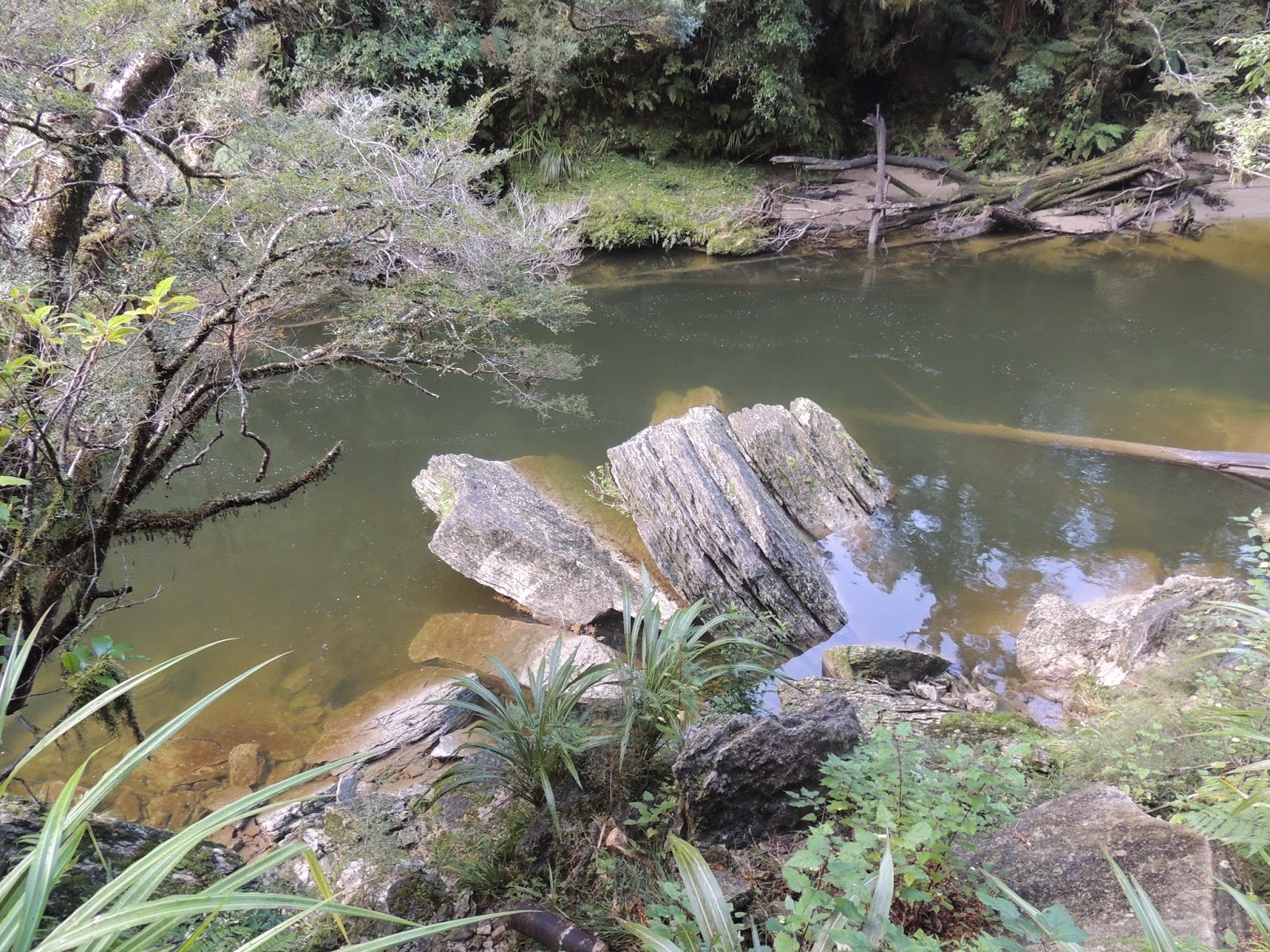
Massive blocks of limestone lay where they tumbled eons ago.



Seen the back of Art's perfectly waterproof jacket one time too many? Purchased in the Fingerlakes region of upstate NY a few years ago (love to Fletch and Denise), it's NZ perfect.


These banded trees remind me of okapi legs.

There are no okapi in NZ


A diverse and stimulating seven-mile hike, which continues for hours if you choose as the Inland Pack Track. Back across the street to check out the tavern's lunch menu--a fishburger hits the spot.


Upon returning to the caravan, a surprise: warm cheesy scones from our campground host, delivered. A camp to remember.

Tomorrow we'll hit the coast road again, from Punakaiki to Hokitika, passing through Greymouth (population 10,000), the largest city on the west coast, accounting for 41% of its population.
Saturday, May 23, 2015
Subscribe to:
Posts (Atom)