New Zealand's rocks record examples of almost every kind of volcanism observed on Earth, including some of the world's largest eruptions in geologically recent times. More here.
Back to the deck as the clouds clear and a little sun brings depth to the hills hugging the shore.
We stocked up for the next leg of the trip tomorrow, when we'll head north into the wilder portions of the peninsula (a reminder that soon I'll be writing "last leg of the trip").
Quick stop at the Bank of New Zealand to put our account in limbo. Do you notice anything odd about these hours?
Just a hop skip from Coromandel Town and a turn down the renown 309, which bisects the peninsula (and is called a shortcut, though parts are gravel and very skinny), are two worthy destinations, with a tasty third on the return trip. First stop is the Waiau Kauri Grove.
Preview: these kauri are enormous
Actually the first stop on the trail is the washing station. Kauri dieback disease is a serious business.
Remove soil, spray, and scrub-walk over the grate to remove still more.
From a distance, the mighty kauri grove looms.
The large volume of timber was one of their greatest vulnerabilities--that and their perfect lines for ship masts.
The Waipoua Forest in Northland is home to the world's oldest and largest known Kauri trees. Tane Mahuta "Lord" or "God" of the forest has his roots in Maori legend and is the largest known kauri tree in the world and estimated to be 2,000 years old. Standing at over 51 metres high, it has a girth of nearly 14 metres. More here.And here's a photo from that website...
There's no way to adequately show how enormous these trees are.
Look at all the life on this tree.
And more in its highest branches.
A memorable visit to nobility.
You wash on the way out too (someone needs a haircut).
Just down the road is Waiau Falls, a charmer of a tumble.
Passion and art collide and, boom, we're gobsmacked by one human's vision. We first heard about Driving Creek Railway and Potteries back in Mount Maunganui, when I asked our host what we should be sure to do on the Coromandel. Well, he, said, there's this guy up near Coromandel Town who started a small-gauge railway so he could go get the clay he needed to do his art and it's pretty cool.
Or pretty strange. But what a wild afternoon learning about Barry Brickell, who died just last year at 80.
I'm going to let the website do the talking, inserting photos of our walk around the store and sculpture garden and our big trip on the narrow-gauge railway. Click here for the website.
Driving Creek’s founder Barry Brickell purchased the present day
Driving Creek property upon which the railway and pottery sit in 1973.
The property was attractive to Barry for its ‘yellow plastic clay’,
derived from the weathering of the old volcanic rocks. There was a
scattering of pine trees amongst scrub, self-sown from original pines
planted by the early Californian gold diggers of late 1800 century. The
property was a mix of scrub and farmland, poor quality pastures that
Barry quickly started reverting to native forest.
Most of the raw materials for the making of terracotta pottery garden
wares, tiles and sculpture come from the upper slopes of the property.
As a railway enthusiast the property provided Barry with the
opportunity to create a replica of the Ongarue bush tramway that he had
visited in earlier years, a railway that has long since vanished.
The railway would provide a practical and environmental advantageous
way to provide all weather access to clay and pine wood kiln fuel for
the pottery. However, we suspect it was more about Barry being able to
play trains on his own railway, an interest that allowed him to also
explore his love of engineering.
Through an extraordinary tunnel on the train
Barry poured considerable money into railway construction before
it was licensed to carry fare-paying public in 1990. This was a huge
financial gamble that paid off with returns from the pottery steadily
diminishing.
Look at that tiny 15-inch track!
The train cars, all built on site, are driven from both the front and back. Periodically on our journey we came to the end of a track, reversed the train, and started climbing up an adjacent track. This because the track couldn't be laid tightly enough to make these turns to gain elevation.
Manual track switch
Early on Barry embarked on a significant conservation programme that
continues today to return the property back to its pre-European state.
Thousands of young Kauri, Totara and Rimu have been planted. As a keen
conservationist Barry built a 1.6-hectare predator free fenced wildlife
sanctuary and sculpture park.
The land on which this is all constructed is a wild tangle of the natives Barry planted, backed by Dept of Conservation property.
The present day Driving Creek Railway climbs 2.7km from the Base Station
at 55 metres above sea level to EyeFull Tower at 167 metres above sea
level, a total climb of 115 metres. With an average gradient of
1-in-24.1 (1 vertical metre for every 24.1 metre of length) the Driving
Creek Railway is New Zealand’s steepest railway.
Sculpture delights periodically along the journey.
You can read much more about the railway here. Vast portions of it were built by Barry himself. Here's an aerial view from the website.
Pulling into the Eyefull Tower, a lookout three stories high.
Our little train looks like a toy.
More art on top of the Eyefull. Glass eels!
There are big views up here looking out over the Hauraki Gulf toward Auckland.
Our driver gave us a precis on Barry and his life (I'm wondering if we're living as devotedly as Barry).
On the return trip, the driver pointed out Barry's grave marker. He told us that Barry had had time in the short space between diagnosis and death to ensure his life's work (and the workers who keep it running) were covered. And, he said, there was a LOT of paperwork in order for Barry to be laid to rest here.
I did a double-take on this lifelike piece.
Artists from all over the world visit the pottery and stay to create.
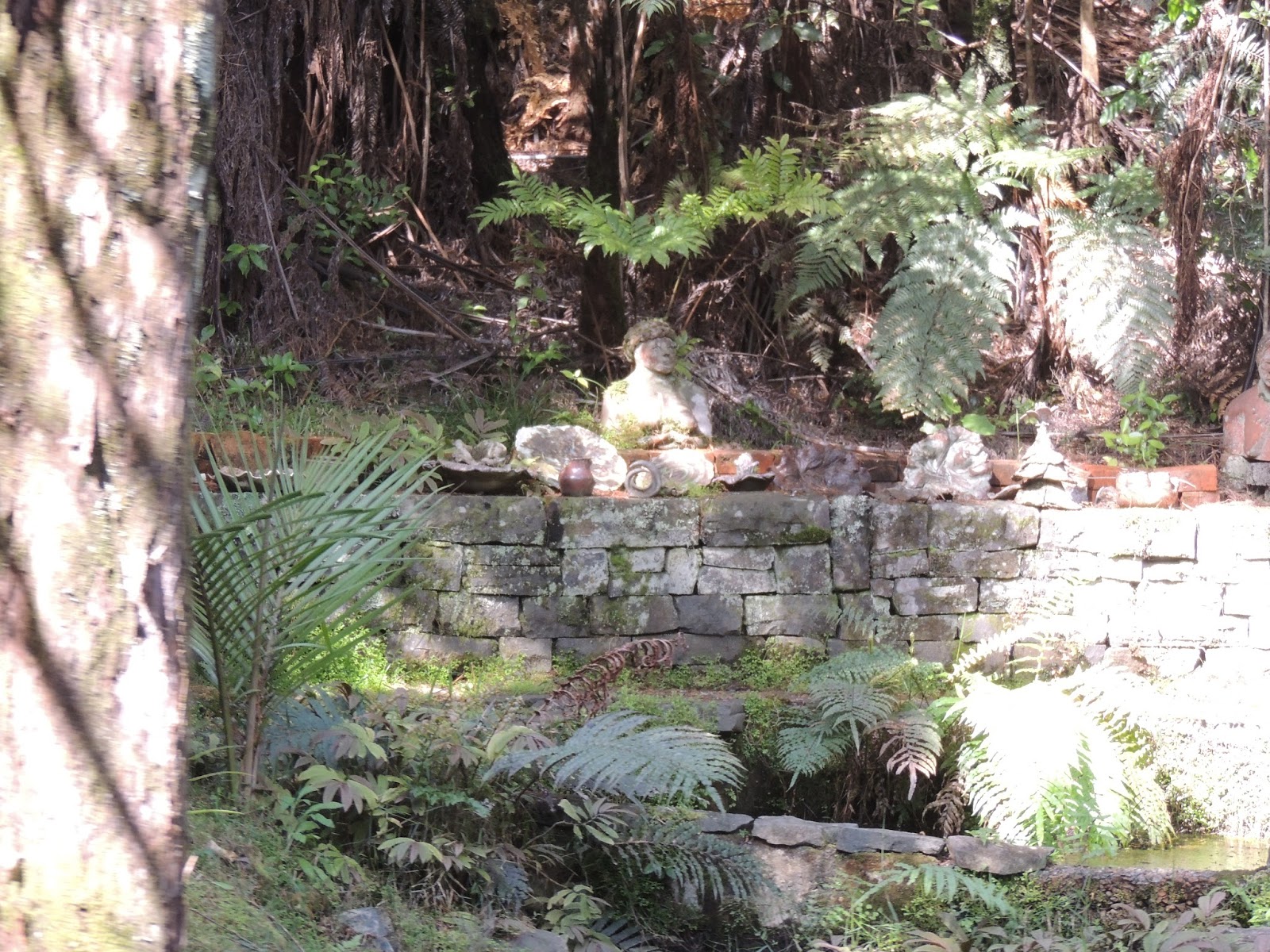
We strolled the sculpture garden when we got back.