Monday, April 22, 2019

Tane Mahuta, Lord of the Forest

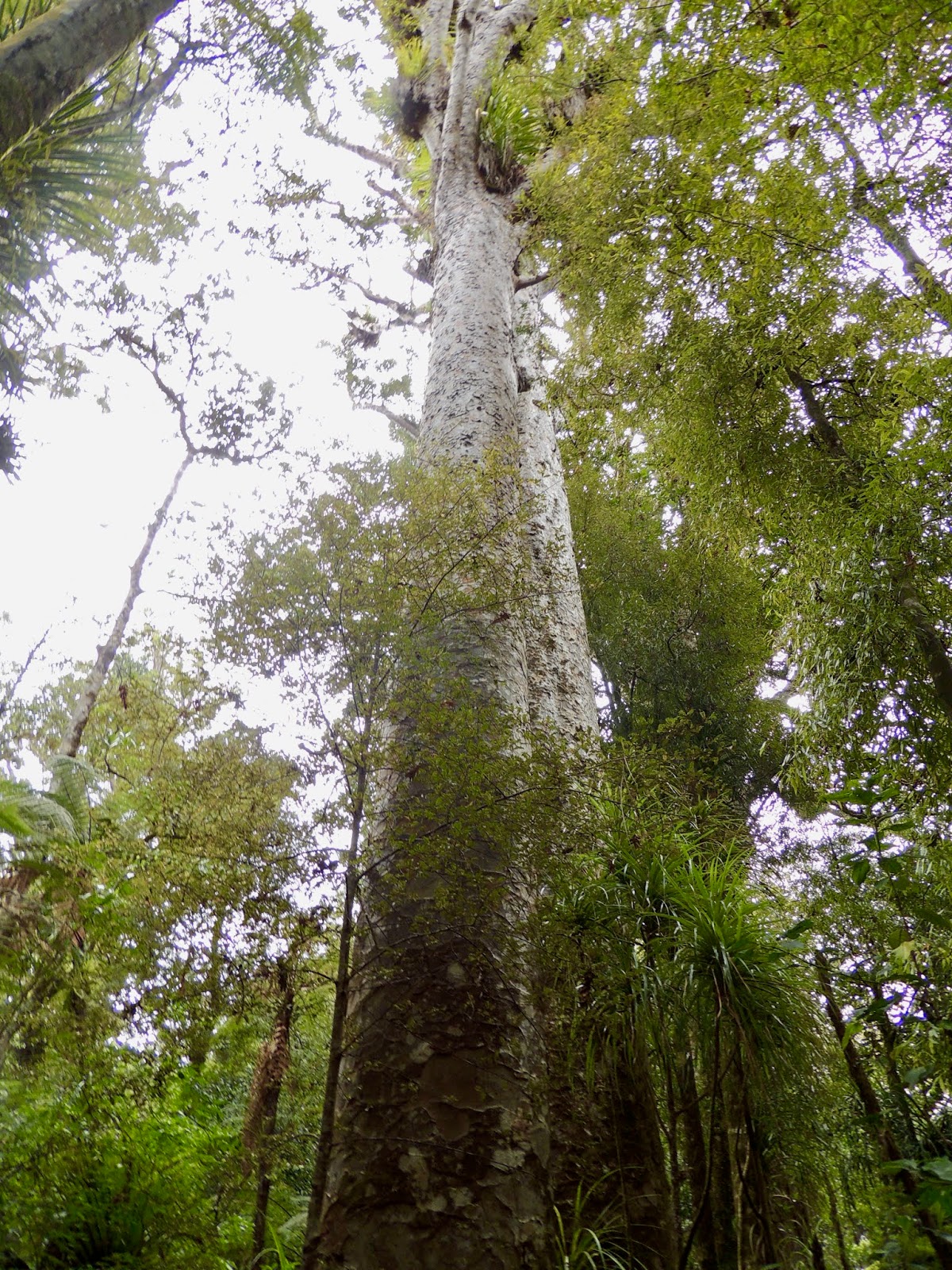
Today we stood in the presence of Tane Mahuta, the largest kauri tree in the world. It is virtually impossible to capture its majesty in a single photo, not to mention its energy.
 

This Guardian piece is so nicely written I'm quoting from it...
Just a short walk down a wooded gangway into the rainforest of Waipoua, near Dargaville on New Zealand’s north island, is a living giant. Its name is Tāne Mahuta and it’s a kauri tree – one of the largest types (by girth rather than height) in the world. Tāne is named after the Maori forest god and, in the myth, is the fruit of the primordial parents: his growth having broken apart the embrace of Ranginui, the “sky father” and Papatūānuku, the “Earth mother,” allowing the space and light for life to flourish.
 

Walk beneath Tāne, which is 51.5 metres tall and has a trunk girth of 18.8 metres (a challenge for the most ardent tree-hugger), and you can’t help but feel moved – and incredibly small. It isn’t just physical majesty that brings tourists flocking to Waipoua to visit “the lord of the forest,” it is the atmosphere around the tree.

200,000 people visit Tane Mahuta annually

This photo from the Guardian captures something of its immense presence.

“Sometimes people are overwhelmed and end up crying,” says Vanessa Rapira of the Te Roroa tribe, who is employed by the Department of Conservation to be near Tāne in all weathers and to serve as its ambassador and its protector. “It is the energy that the visitors pick up, not only from Tāne Mahuta but also the surroundings,” she says.

Trounson Kauri Park

Yesterday we took a field trip to the Trounson Kauri Park not far from our campground. And suddenly we're back humming Joni Mitchell's "Took all the trees, put 'em in a tree museum." Only there's no charge to stroll the Department of Conservation's 40-minute walkway and gawk at these gentle giants while feeling every muscle in your body slowly relax into contentment.

Trounson Kauri Park is the antithesis of the Kauri Museum we visited last week. The former was established as a 1100-acre gift and is a densely biodiverse landscape dominated by mature kauri (Agathis australis) that command you to breathe deeply and look up. Plus lots and lots of birdsong.

The museum is more an homage to resource extraction, though some of the exhibits were instructive in showing the size of these monster trees and the gorgeous pieces fashioned of their wood.


See the slab below

Full disclosure: Art would have liked to take it home.


And yet...
Kauri forests once covered 3 million acres from Northland to Te Kauri, near Kawhia and were common when the first people arrived around 1,000 years ago.

The introductory material at the Trounson Kauri Park takes a decidedly different tack than the museum.


 Park benefactor, an early settler


Walking through this forest feels like a sacred act. One doesn't necessarily notice the kauri right away. Like ghosts, they seem to emerge out of nowhere.


I'm reminded of a phrase in this Letter to London from a young Extinction Rebellion activist: The aim of these protests is "to create moments in time when humanity stops and fully considers the extent of the harm we have done and are doing to life on earth." (Amen.)

In order to grasp the motivation for immense tracts of kauri to be razed, here's a summary through the lens of NZ Dept of Conservation:
Maori used kauri timber for boat building, carving and building houses. The gum was used as a fire starter and for chewing (after it had been soaked in water and mixed with the milk of the puha plant).

The arrival of European settlers in the 1700s to 1800s saw the decimation of these magnificent forests. Sailors quickly realised the trunks of young kauri were ideal for ships' masts and spars, and the settlers who followed felled the mature trees to yielded huge quantities of sawn timber of unsurpassed quality for building.

The gum too, became essential in the manufacture of varnishes and other resin-based products (ed. note: including linoleum). The gum was obtained through digging, fossicking in treetops, or more drastically, by bleeding live trees. More forest was cleared as demand for farmland and timber increased in the early and mid 20th century.

Today most large kauri trees grow in protected government preserves. We'll be visiting the largest kauri in NZ tomorrow, on our way to somewhere.


This, from a remarkably salient piece in the NYT (The Earth Is Just Alive As You Are), struck me as germane in pondering the vast tracts of kauri extracted from NZ since the 1800s...
The Amazon sustains much more than itself, however. Forests are vital pumps of Earth’s circulatory system. All of the water that gushes upward from the Amazon forms an enormous flying river, which brings precipitation to farms and cities throughout South America. Some scientists have concluded that through long-range atmospheric ripple effects the Amazon contributes to rainfall in places as far away as Canada.


Today kauri face a new threat. Kauri dieback is a fungus-type disease, Phytophthora agathidicida (PA), which is having a devastating effect on New Zealand’s kauri forests in Northland, Great Barrier Island and, potentially, the Coromandel Peninsula.
There is no known cure for kauri dieback, but we can help reduce its spread by cleaning boots and equipment and avoiding kauri tree roots. Any movement of soil around the roots of trees could spread the disease.
If this prevention works, it's simple. Use the built-in brush to scrub the soles of your shoes and then step on the green rectangle to get a spray of disinfectant.


Immense gratitude at the foot of these survivors.


Friday, April 19, 2019

Live At Baylys Beach

To view this vid at our site, click here.


Baylys Beach

Here we are at Baylys Beach on the West Coast for the long NZ Easter weekend, the campground filling steadily, families and friends coming together for the holiday. There are vintage caravans and new ones, tents, people staying in the wee baches, and a monster beach a couple blocks away. At 107 km long it's part of NZ's longest driveable beach.

I'm a little conflicted about cars on beaches, but with the tide out there's room for rush hour traffic on this broad sandy margin of the Tasman Sea. A sign says it's safest to drive two hours before and after low tide, when the sand is hard, and to avoid being stranded when the tide comes in. Understatement!

We've been hiking around the golden dunes, doing some serious up and down.

This morning on my way to the kitchen I accidentally got caught up in a rugby game being played next to our caravan. One of the elders told the kid with the ball: throw it to the lady, she wants to play. So I put down my stuff on the grass and successfully caught the easy toss, acquitting myself less splendidly on the throw-back, but at least I didn't fumble.


Here's a 1970s truck camper, made in NZ. The nice people here with it are just trying it out.

 Cafe that I wish were open.


Here's a map of our location (click here if you can't view), just a few minutes west of Dargaville:

Dargaville is built along the edge of the wide Northern Wairoa River, two and a half hours drive north-west of Auckland. Maori settlements and marae (meeting places) have been scattered around the area for hundreds of years. 

The township of Dargaville was established by Irish businessman Joseph McMullen Dargaville in the 1870s, during the heyday of kauri felling and gum digging. It was largely settled by Dalamatian immigrants, whose descendants still live there today. Dairy farming is the main local industry; the district also produces around two thirds of New Zealand’s kumara (sweet potato) crop.


There's a close-knit beach community here, nestled in the hills.


On our return we ran into this woman contemplating where to set the pavers in her new garden area. She has a good eye. Her outdoor space was peaceful and the energy flowed freely.


Wednesday, April 17, 2019

Rare Kakapo Parrots Have Best Breeding Season On Record

Via BBC...

Kakapos - the world's fattest species of parrot - have had their most successful breeding season on record, according to New Zealand's Department of Conservation (DOC).

The flightless, nocturnal parrots were once one of the country's most common birds, but only 147 adults are left.

This year, 76 chicks have been hatched under the DOC's conservation scheme, with 60 expected to reach adulthood.

The new batch is more than double that of the last breeding season in 2016.
Click here for more...

Tuesday, April 16, 2019

Pahi Beach Holiday Park on Kaipara Harbor

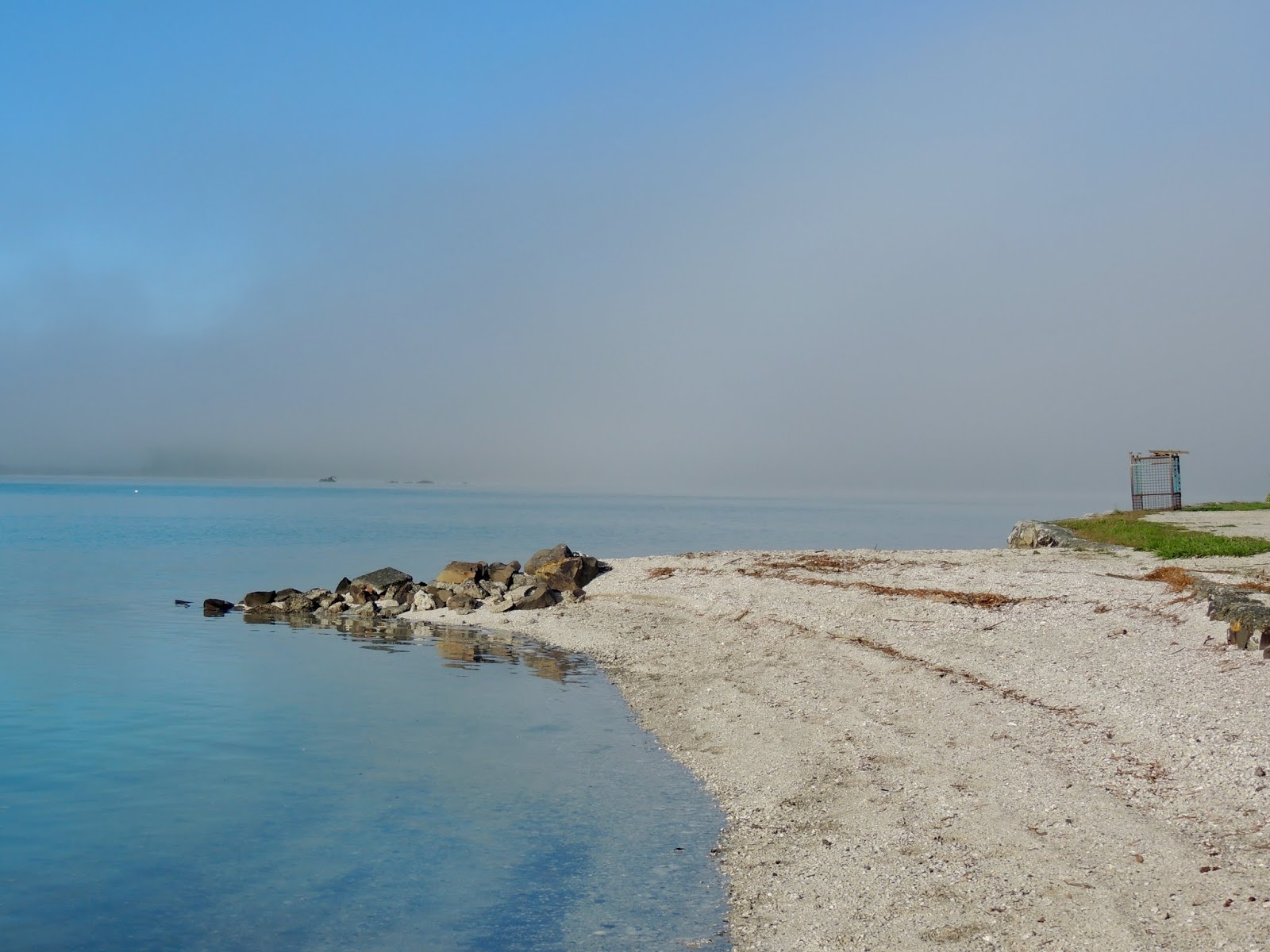
Pahi Beach Holiday Park is situated on the calm shores of one of the inner arms of Kaipara Harbor, NZ’s largest harbor. I made my way out to the shore this morning for some pictures as a dense fog lifted to reveal a brilliantly sunny day.


Here's a location map (if you can't view please click here).


We've had a sweet couple of days here, among the friendliest of Kiwi campers and plenty of fisher people.

The campground sits across from the water, adjacent to the giant fig.
 
Here's Art in the well-appointed shared kitchen, doing the breakfast dishes.

  A neighbor's sticker

Today we went to the nearby Kauri Museum and I can hear you all singing Joni Mitchell's "Cut all the trees, put 'em in a tree museum, charged the people a dollar and a half just to see 'em." It was a little bit like that, but also intensely informative. Pictures another day. Tomorrow we're driving west to the coast., seeking ever wilder spots.

Dinner: cheese (including the green cheese from the market), sausage, and copious vegetables.